
Summary of Findings
The baking zone is the band in which electrode paste changes from liquid material into solid, electrically conducting carbon at approximately 450–500 °C. In normal operation, it sits above the lower end of the contact shoes. Its position shifts with current, slipping cadence, paste properties, and heat removal, so each furnace must establish its own operating reference.
Key Findings
- The baking zone is where paste becomes conductive carbon, at approximately 450–500 °C. Above it the column is plastic and effectively non-conducting; below the shoes, baking is complete and the material carries load.
- Three operating variables move it. Electrode current raises the zone; a faster slipping rate lowers it; higher volatile matter lowers it, since more gas must evolve before the transition completes.
- Current dominates only in high-current-density operation. In such operations electrode current is the most important parameter for zone position, while in low-current-density operations the same current is of less importance (Larsen) — which is why a rule of thumb carried between two furnaces frequently misleads.
- A zone that sits too low produces soft breakage; a zone that has been passed too slowly produces over-baking and brittle fracture. Where a casing defect coincides with unbaked paste, green paste can run out into the furnace room (Larsen).
- Published positions are case-specific. The figures cited here belong to identified case-study electrodes at stated diameters and currents; each plant must establish its own working position from its own records.
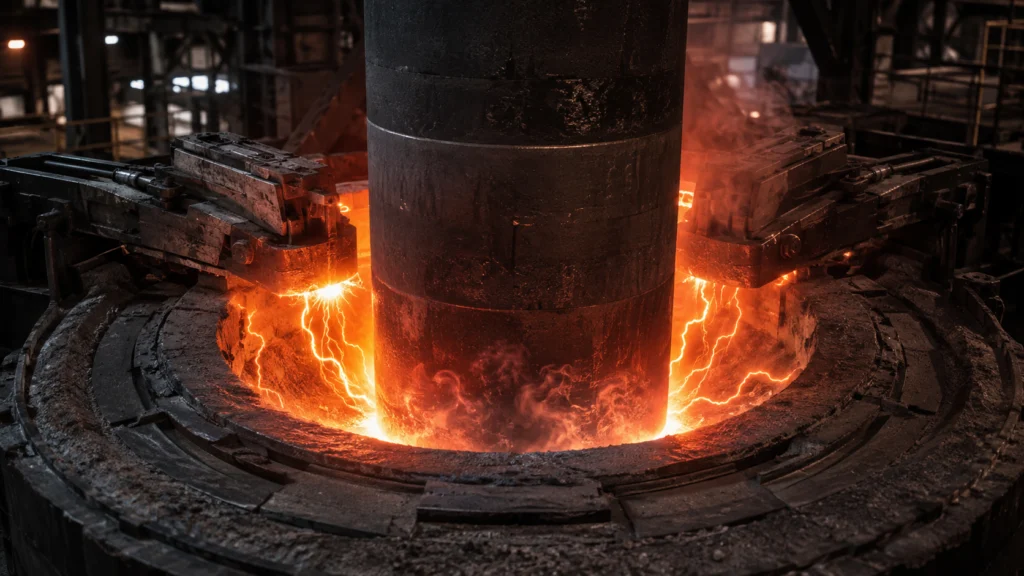
Table of Contents
- What is the baking zone, and where does it normally sit?
- What moves the baking zone up or down?
- Why does its position determine the failure mode?
- How can its position be inferred without instrumentation?
- What should be done after a load change or a batch change?
- Frequently asked questions
- Related reading
What Is the Baking Zone, and Where Does It Normally Sit?
The baking zone is the band of the electrode column in which the paste is converted from the liquid to the solid state and where the material starts conducting electricity. Published work places this transition at approximately 450–500 °C, while sectioning of an operating industrial electrode identified a narrower 450–475 °C transition band (Larsen; Glastonbury et al., Metals).
Position is conventionally expressed as a distance above the lower end of the contact shoes. Buyers reviewing this operating behaviour should also compare the applicable electrode paste specifications with the furnace conditions. This convention matters because it fixes the reference for everything else: above the zone the column is soft paste, within it the material is transitioning, and below the shoes it is baked and load-bearing. The fracture zones used in field breakage diagnosis are defined against the same datum.
The zone is a band rather than a plane. Heat enters the column from the current flowing through it and from the furnace below, and leaves through the casing and the shoes, so the isotherm is curved — reaching further up at the centre than at the perimeter. A single reported “position” describes where that surface crosses a chosen radius, not a flat boundary.

Figure. The baking zone sits above the lower end of the contact shoes. Current raises it, while faster slipping and higher volatile matter lower it. The isotherm is curved, not flat. Schematic; not to scale.
What Moves the Baking Zone Up or Down?
Electrode current. Current flowing through the column generates resistive heat within it. More current brings the material to the transition temperature sooner — that is, higher up the column — so the zone rises. The strength of this effect is not uniform across furnaces: in high-current-density operations electrode current is the most important parameter for zone position, whereas in typical low-current-density operations it is of less importance (Larsen).
Slipping rate. Slipping advances unbaked material downward. The faster the advance, the less time any given section spends in the heated region before it reaches the shoes, and the lower the zone sits. A published case study shows the same directional relationship: when slipping was increased substantially, the reported baking-zone position moved downward. The authors described the change as excessive and did not recommend transferring it as an operating target (Larsen).
Paste properties. Higher volatile matter requires more gas to evolve before the transition completes, which lowers the zone; lower volatile matter raises it. Softening point acts earlier, on whether the paste melts and levels properly at the paste level, and therefore on the uniformity of what arrives at the baking zone in the first place.
Heat removal at the shoes. Shoe and casing cooling, fin geometry and the condition of the contact surfaces all set how much heat leaves the column at that height. One reported intervention on a furnace with electrode-management problems combined a current-density limit with enlarged fin-window areas (Wilkinson et al., Infacon IX). The case illustrates that casing hardware and cooling must be considered alongside paste properties when evaluating the thermal balance.

Why Does Its Position Determine the Failure Mode?
Because the zone position decides what kind of material is present where the column has to carry load.
A zone sitting too low means unbaked or partially baked material is present at heights where self-weight and electromagnetic loading act. A baking zone far below the clamps can cause soft electrode breakages (Larsen); the field evidence is explained in JY Carbon’s hard-versus-soft breakage diagnostic guide. The associated secondary risk is severe: where a hole in the casing coincides with unbaked paste, green paste can flow out into the furnace room (Larsen), and paste entering the charge contaminates the heat.
A zone that a given section passes through too slowly produces the opposite condition. The material completes baking and then continues to reside in the heated band, the binder phase carbonises beyond the intended degree, and the resulting carbon is brittle. Fracture then occurs within the fully baked section, with a dry fracture face.
There is also a transient case that belongs to neither. Where high slipping rates, high electrode current and increased electrode movement occurred together, cracks were generated before the electrode was fully baked and cured (Wilkinson et al., Infacon IX). Cracking of this kind is set up before the material reaches its service position and only becomes visible later, which is why a breakage investigation examines the operating record of the preceding days rather than only the moment of failure.
How Can Its Position Be Inferred Without Instrumentation?
Few operating furnaces measure the isotherm directly. Four indirect indicators, read together, are sufficient for working purposes:
- Casing surface temperature profile at and above the shoes. Measured at fixed points on a fixed schedule, the profile shifts when the zone moves. Absolute values matter less than the change against that furnace’s own history.
- Off-gas character. Persistent low off-gas temperature at comparable load suggests little volatile matter remains to evolve — the zone is high and residence long. Elevated tar suggests the opposite.
- Slipping response. Where a standard slipping increment produces a smaller electrical response than usual, the material arriving below the shoes differs from the material that was arriving before.
- Breakage history by type. A run of soft breakages indicates a zone sitting low; a run of hard breakages indicates over-baking. Classification method is set out in the diagnostic guide.
None of these is a measurement of the isotherm. They are a means of detecting that it has moved, which is what operating practice actually requires.
What Should Be Done After a Load Change or a Batch Change?
Both events move the zone, and both are foreseeable — which makes them manageable in advance rather than after a breakage.
After a sustained load change. A load reduction lowers resistive heating and lowers the zone. The slipping cadence calibrated at the previous load is then too fast for the new thermal condition. Reduce slipping before the load is reduced where the change is planned, and monitor the casing temperature profile and breakage type over the following days.
After a paste batch change. Compare the new and previous batch on volatile matter, ash and softening point before the batch enters service. A batch with materially lower volatile matter, still within range, will raise the zone and lengthen effective baking at an unchanged cadence — which is the over-baking route. A controlled electrode-paste trial is the appropriate mechanism.
After a shutdown and restart. The column cools and the zone effectively disappears, then re-establishes as load is restored. A slow load ramp during initial energisation leaves the transition zone under-baked for a period, and it is during that period that the column is most exposed.
Frequently Asked Questions
What is a correct baking zone position for our furnace? There is no transferable figure. Published positions belong to identified case-study electrodes at stated diameters and currents; a value from one furnace does not carry directly to a different diameter or current regime. Establish the working position from your own records: log casing temperature profile, slipping cadence and breakage type together over a period of stable operation, and treat the condition prevailing during that period as the reference.
Can the zone be moved deliberately? Yes, through slipping cadence and load, and to a lesser extent through shoe cooling. The constraint is that both primary levers have other consequences — slipping cadence sets column length and load sets production — so the zone is normally managed within the operating window rather than targeted directly.
Does a higher current always raise the zone? Directionally yes, but the magnitude depends on the operating regime. In high-current-density operation electrode current is the dominant parameter for zone position; in low-current-density operation it matters less (Larsen). A rule of thumb transferred from a high-current furnace will overstate the effect on a low-current one.
We have never had a breakage. Do we need to track this at all? The zone position also governs consumption and electrical stability, not only breakage. A column that is chronically over-baked consumes faster; one that is chronically under-baked shows unstable current transfer at the shoes. Tracking is worthwhile before a failure makes it necessary.
Does closed-top or open-top operation change the picture? It changes the gas escape path and therefore the thermal balance around the paste level, which is one reason closed-top and standard pastes carry different volatile matter ranges. The mechanism described here is the same in both; the working position and the acceptable slipping window are not.
Related Reading
- What Volatile Matter Actually Does Inside a Söderberg Electrode — the material behaviour underlying the transition described here
- Anatomy of a Söderberg Electrode System — the hardware around the column: casing, shoes, holder, and slipping mechanism
- Irregular Current Transfer Around Söderberg Electrode Contact Shoes — the electrical consequences at the same height
Author and Review
Written by Sterling Yang, Senior Vice President at JY Carbon, and technically reviewed by Mr. Yang, Technical Director at JY Carbon.
All numerical values in this article are attributed to the published sources listed in Appendix B and belong to identified case-study electrodes at stated diameters and currents. They are not design values and should not be applied to a different furnace without verification. Working positions, slipping windows and casing temperature references are established by each plant from its own operating records.
Technical Consultation
For assistance in reviewing slipping cadence against a paste specification, or in assessing an electrode management change before it is made, please contact the technical team.


