
Summary of Findings
Volatile matter is not an impurity to be minimised. It is the part of the binder phase that evolves as gas during baking, and the paste depends on it twice: as the fraction that keeps the paste plastic enough to fill the casing and level out, and as the fraction whose departure completes the carbon structure. Baking — the conversion from liquid paste to solid, electrically conducting carbon — occurs at approximately 450–500 °C (Larsen, Platinum 2012), with the transition reported at 450–475 °C in a sectioned industrial electrode (Glastonbury et al., Metals, 2021).
That dual role is why the specification states a range rather than a ceiling. Above the range, devolatilisation is incomplete when the material reaches the load-bearing zone; below it, the binder fraction is insufficient and the baked carbon is porous and weak. Industrial paste has been reported at 10%–13.8% volatile matter across suppliers (Wilkinson et al., Infacon IX), and YB/T 5215 sets the ranges for standard and closed-top grades.
Key Findings
- Volatile matter is the gas-forming fraction of the binder, not a contaminant. It leaves across the baking transition at approximately 450–500 °C, and its departure is what converts paste into conducting carbon.
- Two failure directions, not one. Above the specified range, a partially baked layer persists at the transition zone; below it, the carbon structure after baking is loose and mechanically weak. The diagnostic consequences of each are treated in the companion article on hard and soft breakage.
- Volatile matter cannot be read alone. Binder softening point governs whether the paste melts and levels at the operating current density; reported values across suppliers span 53–75 °C, and a value suited to a high-current furnace behaves differently in a low-current one (Wilkinson et al., Infacon IX).
- Baking sets up an internal stress the paste must survive. Coal tar pitch baked at 475 °C shrinks approximately 12% on further heating to 1300 °C, while calcined anthracite aggregate expands by less than 1% (Glastonbury et al., 2021). The carbon structure must accommodate that differential.
- The measurement is method-specific. Volatile matter for electrode paste is determined by YB/T 5189—2022, and no international method standard covers the parameter for this material.
Contents
- What is volatile matter in electrode paste, and when does it leave?
- Why is a range specified rather than an upper limit?
- What happens when volatile matter is above the range?
- What happens when it is below the range?
- How does volatile matter interact with softening point?
- Frequently asked questions
- Related reading
1. What Is Volatile Matter in Electrode Paste, and When Does It Leave?
Electrode paste is a granular carbon aggregate — typically calcined anthracite, with coke and graphite fractions depending on grade — held together by a coal tar pitch binder. Volatile matter is the portion of that binder which evolves as gas on heating rather than remaining as solid carbon. It is measured on the unbaked paste, by the method specified in YB/T 5189—2022.
Its departure is not a side effect of baking; it is baking. Below the transition the material is plastic and effectively non-conducting; above it the binder has carbonised into a coherent solid that carries current. The transition is reported at approximately 450–500 °C (Larsen, Platinum 2012), and sectioning of an operating industrial electrode placed it at 450–475 °C (Glastonbury et al., 2021).
The gas must also leave. Devolatilisation generates internal pressure, and the escape path runs upward through material that is still permeable. Where the outer layer has already baked while the interior has not, the gas has no route out, and the structure is loaded from inside at the moment it is least able to carry load.
Figure 1. Volatile matter leaves across the baking transition at approximately 450–500 °C; the binder that remains carbonises and continues to shrink well above that temperature, while the aggregate does not. Schematic; not to scale.
2. Why Is a Range Specified Rather Than an Upper Limit?
Because both directions fail. A specification that only capped volatile matter would be satisfied by a paste with too little binder, and such a paste produces a mechanically weak baked structure.
The range also has to accommodate the furnace. Closed-top furnaces and open-top furnaces impose different constraints on how gas leaves the electrode, which is why YB/T 5215 separates closed-top paste from standard paste and assigns them different ranges. The selection logic between the two is treated in the Selection Guide.
The practical consequence for a buyer is that a volatile matter figure is meaningless without the grade it belongs to. A value that is out of specification for standard paste can be mid-range for closed-top paste. Any comparison of two supplier reports must first establish that both are quoted against the same grade.
3. What Happens When Volatile Matter Is Above the Range?
Devolatilisation remains incomplete when the material reaches the zone where it must carry load. A partially baked layer persists at the transition between soft paste and baked carbon, and that layer cannot sustain the self-weight of the column together with electromagnetic loading.
Three observations usually appear together:
- The fracture face, if the column fails, exposes soft paste — tacky, glossy, sometimes extruded. This is the signature of soft breakage.
- Off-gas tar content runs elevated, consistent with volatile matter evolving later and higher in the column than intended.
- Paste level control becomes harder, because the liquid fraction is larger than the operating practice was calibrated for.
The secondary risk is the one that matters commercially. Paste extruded into the charge contaminates the heat, and the loss exceeds that of a short unplanned shutdown by a wide margin.
4. What Happens When It Is Below the Range?
The binder fraction is insufficient to fill the space between aggregate particles. After baking, the carbon structure is porous and its mechanical strength is reduced; electrical resistivity rises for the same reason, since conduction depends on continuous carbon contact between particles.
The failure mode is brittle rather than plastic. Fracture occurs within the fully baked section, the fracture face is dry and bright with no paste extrusion, and the event is usually accompanied by an audible crack and a flare-up. Over-baking produces a similar end state by a different route — it removes volatile matter that was present in the material — which is why the diagnostic path for hard breakage checks operating cadence before it checks the Certificate of Analysis (COA).
A low volatile matter batch also changes the operating window. At an unchanged slipping rate, material with less volatile matter completes baking sooner and then continues to reside in the baking band, which is over-baking by another name. A batch change in this direction calls for a cadence adjustment rather than a quality claim.
5. How Does Volatile Matter Interact With Softening Point?
Volatile matter describes how much binder will leave. Softening point describes when the binder becomes mobile. A paste can be within range on the first and unsuitable on the second.
Reported binder softening points across suppliers span 53–75 °C, and the consequences of a mismatch run in both directions (Wilkinson et al., Infacon IX). A softening point at the low end proved problematic in high-current operation. At the high end, in furnaces running lower current density, the paste melted insufficiently — producing low liquid paste levels, layering between successive charges, and poor electrode formation.
Layering is worth naming explicitly, because it is often mistaken for a paste quality defect. It is an interface between two charges of paste that did not merge, and it originates in a softening point too high for the thermal conditions at the paste level, not in the composition of either charge.
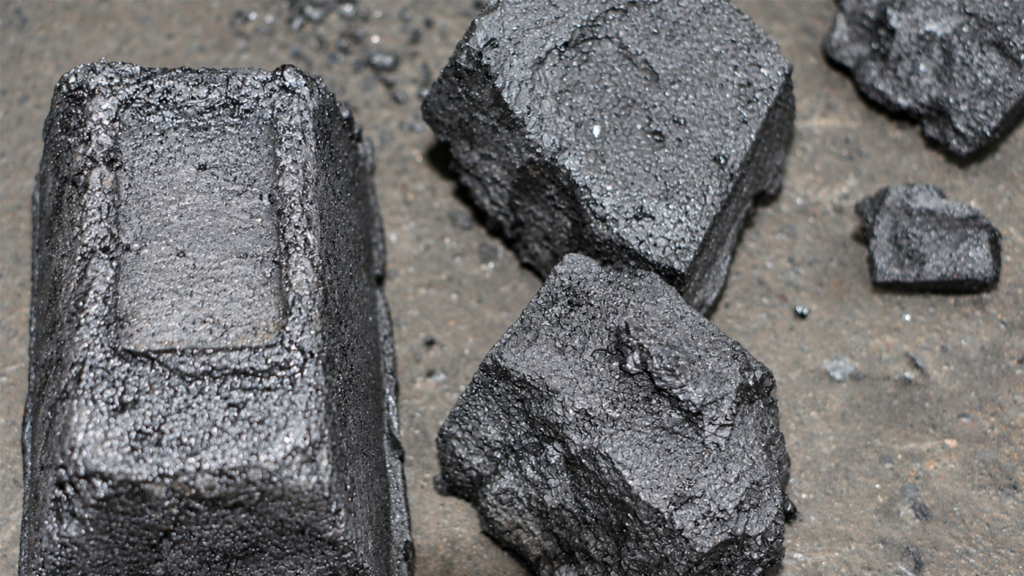
Figure 2. Cut face of an unbaked paste block, showing the aggregate particles and the pitch binder that fills between them; volatile matter is the fraction of that binder which will leave as gas during baking.
6. Frequently Asked Questions
Q1. Is lower volatile matter better quality? No. Volatile matter is a specified range, not a contaminant to be minimised. Below the range the binder fraction is insufficient, the baked structure is porous, mechanical strength falls and resistivity rises. Ash content is the parameter where lower is generally better; volatile matter is not.
Q2. Our COA shows volatile matter in range but the furnace behaves as though it is high. What else should be checked? Softening point first — a paste that melts too readily behaves like a high volatile matter paste at the paste level. Then sampling: a COA reflects the sampling point only, and paste is heterogeneous by construction. Then storage and transit conditions, since the batch as received can differ from the batch as tested.
Q3. Can volatile matter be adjusted after delivery? No. It is set by the formulation and cannot be altered at the furnace. What can be adjusted is the operating response — slipping cadence, paste column height, and load pattern. Where a batch sits at either edge of its range, the cadence should be reviewed before the batch enters service rather than after a breakage event.
Q4. Why do two laboratories report different volatile matter for the same batch? Method and sampling. Volatile matter for electrode paste is determined by YB/T 5189—2022, and there is no international method standard for this parameter on this material, so a laboratory abroad may apply a coal or coke method with a different heating regime. The method number and the sampling plan should both be named in the purchase specification.
Q5. Do closed-top and standard paste ranges overlap? They do, which is why the grade must be stated with the value. A figure that is above specification for standard paste can be mid-range for closed-top paste, and comparing two offers without first aligning the grade produces a meaningless ranking.
7. Related Reading
- Söderberg Electrode Hard Breakage vs. Soft Breakage: A Root-Cause Diagnostic Guide (companion article) — what the two failure directions look like in the field
- How the Baking Zone Forms and Migrates in a Self-Baking Electrode — where in the column the transition described here actually sits
- Electrode Paste Raw Materials Explained — the aggregate and binder fractions behind the parameter
- How Sampling and Sample Preparation Affect Electrode Paste Test Results — why a reported value may not represent the batch
- YB/T 5215 and International Test Standards: A Clause-Level Comparison — why the same batch can return different values in two laboratories
- Why Electrode Paste Requirements Differ Across Ferroalloy, Silicon Metal, and Calcium Carbide Furnaces — how furnace type shapes the target range
Author and Review
This article was reviewed by Mr. Yang, Technical Director at Jiyang Carbon, drawing on 40+ years of hands-on experience in carbon processing.
Temperature values, industrial volatile matter and softening point ranges, and the shrinkage figures cited here are drawn from the published sources listed in Appendix B and are attributed in the text. Specification ranges under YB/T 5215 should be read from the standard text itself. Jiyang Carbon tests seven parameters on every batch in its own laboratory and issues a traceable Certificate of Analysis (COA) with each consignment.
Technical Consultation
For assistance in setting a volatile matter target for a specific furnace type and operating cadence, please contact the technical team.
Get a Technical Consultation →
Revision History
- 2026-09-02 — First publication; reviewed on the same date.
- Next scheduled review: 2026-12-01. Focus on verifying the YB/T 5215 ranges against the current standard revision.


