
An EAF and LF troubleshooting framework for separating oxidation, furnace exposure, cooling, handling and material evidence.
Direct Answer
Graphite electrode sidewall loss can result from oxidation at exposed hot surfaces, uneven furnace atmosphere or heat, cooling or water-related conditions, arc or process instability, mechanical damage, connection effects, or material variation. Diagnose the pattern, location and timeline before changing grade or operation. Corrective action must address the confirmed exposure or defect, not the appearance alone.
Key Takeaways
- Oxidation is a chemical loss mechanism, but abnormal shape can also reflect mechanical or electrical events.
- Map loss along the column and around the circumference rather than describing only total consumption.
- Review furnace exposure, cooling, handling, joints and batch evidence together.
- A product grade change is not the first corrective action without a confirmed mechanism.
- Water, hot equipment and furnace access require site safety procedures.
Table of Contents
- Describe the loss pattern
- Screen the main cause groups
- Build the evidence timeline
- Choose corrective action by mechanism
- What to send the supplier
Describe the Loss Pattern
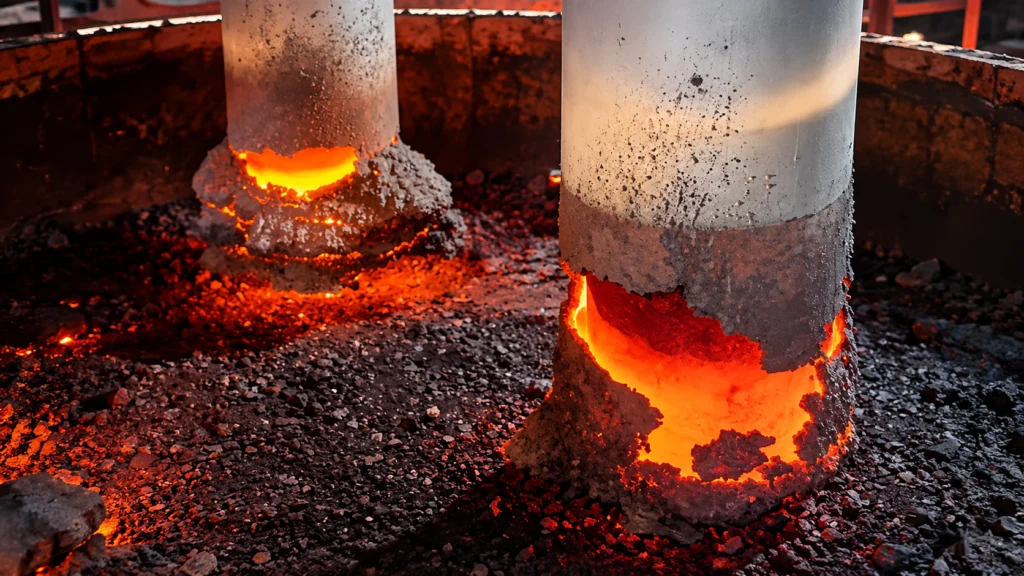
Record whether the sidewall loss is uniform, localized to one side, concentrated near a joint, associated with a visible crack, or linked to a particular furnace position. Note whether the electrode appears tapered, grooved, necked or mechanically damaged. Use consistent, safe photographs and dimensional observations where the site’s procedure permits.
A uniform loss pattern suggests a different diagnostic path from one-sided or localized damage. The shape does not prove the cause, but it helps select which furnace, cooling, connection and material records should be compared.
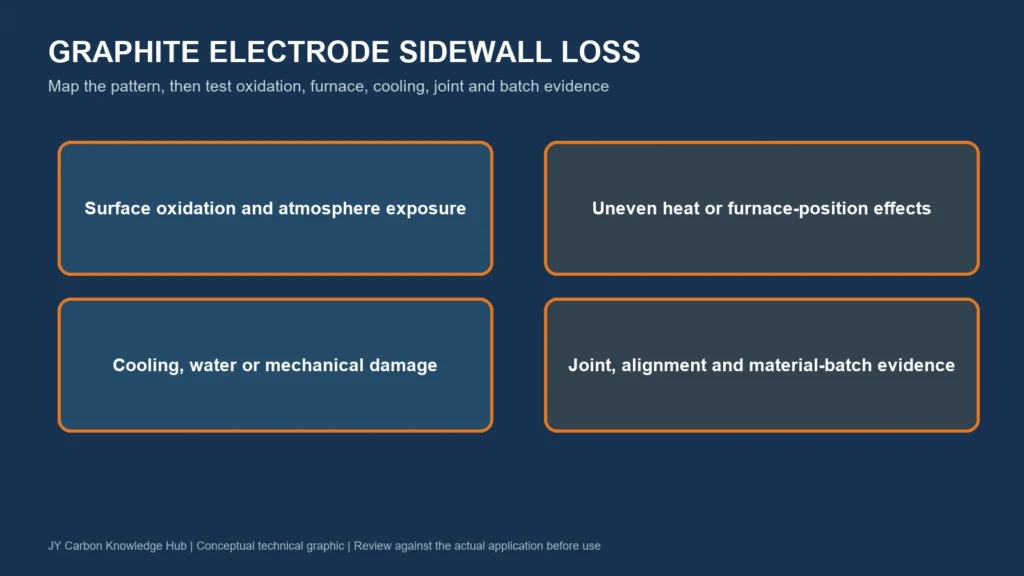
Diagnostic matrix. The observed shape narrows the investigation but does not confirm responsibility.
Screen the Main Cause Groups
Published research identifies gas atmosphere, oxidizing exposure, surface temperature and product condition as factors affecting graphite-electrode oxidation (graphite electrode oxidation study). In an operating furnace, these factors interact with furnace practice. The article therefore uses them as cause groups, not as a remote operating prescription.
| Possible mechanism | Evidence to examine | Useful distinction |
| Surface oxidation | Loss pattern, exposure, furnace atmosphere indicators and hot-zone location | Uniform or exposure-related loss versus impact damage |
| Uneven heat or furnace condition | Position, phase, arc or process history and local furnace observations | One-sided pattern that follows furnace position |
| Cooling or water-related condition | Cooling-system records, leak or spray evidence and maintenance | Thermal or mechanical effects near affected area |
| Joint or column condition | Joint location, connection history, alignment and marks | Loss concentrated around a connection or misalignment |
| Material or batch | Batch test package, receiving condition and comparison pieces | Repeatable pattern linked to evidence from one batch |
Build the Evidence Timeline
Align electrode additions, joints, batch changes, furnace positions, operating events, cooling alarms, maintenance and observed loss. If several electrodes are affected, compare whether the pattern follows one phase, one furnace position, one material batch or the complete system.
Retain identifiable comparison material where practical. Receiving photos and dimensional records can show whether a defect existed before installation. Furnace observations can show whether it developed during exposure. Both are needed before responsibility is assigned.
Choose Corrective Action by Mechanism
- For exposure-related oxidation, review the relevant furnace and cooling controls under site authority.
- For mechanical or joint-related damage, inspect handling, alignment and connection evidence.
- For suspected batch variation, quarantine identifiable stock and review test and receiving records.
- For mixed evidence, continue controlled observation rather than changing several variables.
- Document the action and check whether the loss pattern changes afterward.
Corrective action should be narrow enough to test the confirmed or most evidence-supported mechanism. Simultaneous changes to grade, furnace practice and cooling can hide the effect of each change.
What to Send the Supplier
Send the electrode designation and batch, quality package, receiving condition, connection and handling record, mapped damage photographs, furnace position and relevant event timeline. Use the JY Carbon graphite electrode product page to request review.
Do not send an isolated photograph with a request to guarantee a cause. The supplier can review material and connection evidence, while the furnace team retains responsibility for operating and equipment data.
Sources
- Improvement of Oxidation Resistance of Arc Furnace Graphite Electrodes. Chernye Metally, 2023. https://rudmet.ru/journal/2230/article/36929/?language=en
- ASTM C1179-21 — Standard Test Method for Oxidation Mass Loss of Manufactured Carbon and Graphite Materials in Air. https://store.astm.org/standards/c1179
Written by Sterling Yang,Senior Vice President, Jincheng Jiyang Carbon Co.,Ltd.
Technically reviewed by Mr.Yang,Technical Director.


