
An evidence-first diagnostic guide for investigating an apparent increase in self-baking electrode paste consumption.
Direct Answer
Excessive electrode paste consumption is an observed rate change, not a root cause. First verify the measurement boundary, inventory and addition records. Then compare paste batch and form, storage or contamination, electrode condition, slipping and operating history, furnace load, production basis and abnormal events. A material conclusion is justified only when competing causes have been checked against evidence.
Key Takeaways
- Confirm that the consumption increase is real and measured on a comparable basis.
- Separate inventory or recording loss from actual electrode use.
- Review material, storage, addition, electrode management and furnace operation together.
- Use batch and event timelines to test possible causes.
- Do not change paste or operating practice before the site assesses safety and evidence.

Table of Contents
- Verify the symptom
- Build one timeline
- Check the main cause groups
- Use evidence to narrow the cause
- What to send the supplier
Verify the Symptom
Check how consumption is calculated. Confirm opening and closing inventory, receipts, returns, damaged or discarded material, package quantity basis, and the time or production basis used for comparison. A change in reporting practice, stock count or product mix can create an apparent increase without an equivalent change at the electrode.
Compare periods with similar enough operating context. If production rate, furnace duty, campaign condition or downtime changed, record those differences. Do not normalize the data with an assumed factor that has not been technically approved.
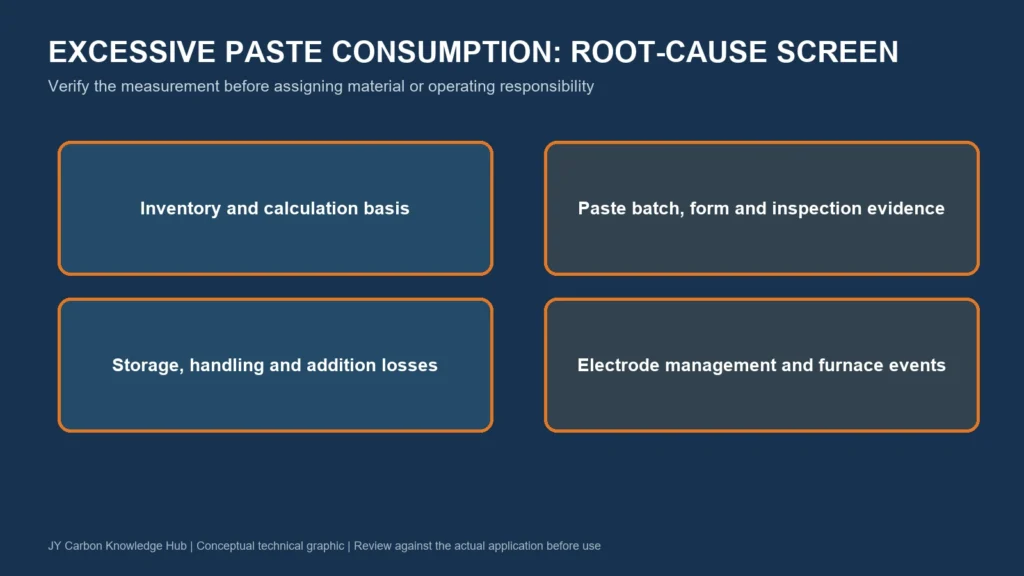
Diagnostic framework. Consumption is a symptom that must be verified on a comparable basis.
Build One Timeline
Align the paste addition record, batch changes, storage observations, electrode movements, furnace events, maintenance and production data on one timeline. The objective is to see whether the consumption change began before, during or after a material or operating change.
Include shutdowns, restarts, electrode incidents and unusual corrections. These events can change paste use or inventory accounting and may also disturb the electrode’s thermal condition. A monthly total without event context is rarely enough for diagnosis.
| Cause group | Evidence to examine | Question before action |
| Measurement and inventory | Stock count, package basis, additions, losses and production basis | Is the increase real and comparable? |
| Material and batch | Product identity, COA, form, receiving and batch transition | Did evidence change with the symptom? |
| Storage and handling | Wetting, contamination, breakage, repacking and discarded material | Was material lost before entering the electrode? |
| Electrode management | Addition, column observations, slipping and abnormal events | Did movement or column condition change? |
| Furnace operation | Load, process condition, shutdowns, starts and electrode incidents | Could furnace duty explain the changed use? |
Check the Main Cause Groups
Industrial case work treats paste consumption as one part of overall electrode performance and reviews material variability, packaging or storage and operation together (electrode paste performance study). Research on paste additions likewise shows that paste level and addition practice interact with electrode management (paste additions and levels paper). These sources support a multi-factor diagnosis, not a public setpoint.
Material evidence may include a batch change, different supplied form or nonconforming test result. Storage evidence may include damaged packages, contamination or unrecorded disposal. Operating evidence may include changes in addition, movement, furnace duty or abnormal electrode events. Each possible cause needs a matching observation and timeline.

Use Evidence to Narrow the Cause
- State the observed change and measurement basis.
- List candidate causes without ranking them prematurely.
- For each cause, identify confirming and contradicting evidence.
- Check whether the symptom follows the same batch or operating condition repeatedly.
- Choose corrective action only after the responsible site team reviews risk.
If the evidence is insufficient, the correct result is “not yet determined.” Continue controlled observation or sampling rather than presenting a convenient explanation as confirmed.
What to Send the Supplier
Send the affected batch and package references, addition and inventory records, relevant furnace timeline, observed electrode condition, photographs that can be shared safely, and comparison data from a reference period. Use the JY Carbon electrode paste page to open a technical inquiry.
Do not send only a consumption total and request a grade change. The supplier needs enough context to separate material conformity from storage, measurement and furnace-system causes.
Sources
- Impact of Electrode Paste on Soderberg Electrode Performance. INFACON IX. https://www.pyro.co.za/InfaconIX/510-Wilkinson.pdf
- Insights into the Influences of Paste Additions and Levels on Söderberg Electrode Management. INFACON X, 2004. https://www.pyro.co.za/InfaconX/045.pdf
Written by Sterling Yang,Senior Vice President, Jincheng Jiyang Carbon Co.,Ltd.
Technically reviewed by Mr.Yang,Technical Director.


