
An application-led framework for understanding why electrode paste cannot be selected from the furnace name alone.
Direct Answer
Electrode paste requirements can differ among ferroalloy, silicon metal and calcium carbide furnaces because their burden systems, furnace designs, electrical practices, thermal environments and electrode-management routines are not identical. The application name is a starting point, not a grade recommendation. Selection requires actual furnace data, agreed test methods and evidence from the operating history.
Key Takeaways
- All three applications may use self-baking electrodes, but that does not make their paste requirements identical.
- The useful comparison is based on furnace conditions and electrode management, not a market label.
- Chemical targets, electrical loading and operating continuity can change which risks receive priority.
- A supplier needs site evidence before recommending a formulation or acceptance target.
Table of Contents
- What remains common
- What changes by application
- How those differences affect the inquiry
- A comparison framework
- What to send the supplier
What Remains Common
In each application, a self-baking system must convert supplied paste into a conductive carbon electrode while the furnace operates. The paste must pass through softening, filling, carbonization and baking without being treated as an isolated laboratory material. Casing condition, heat flow, current transfer, addition and slipping remain connected.
The general mechanism is supported by published descriptions of Soderberg electrode columns and their operating history (real-world electrode characterisation). What changes from site to site is the combination of furnace design, smelting process and operating practice that determines how the mechanism is managed.
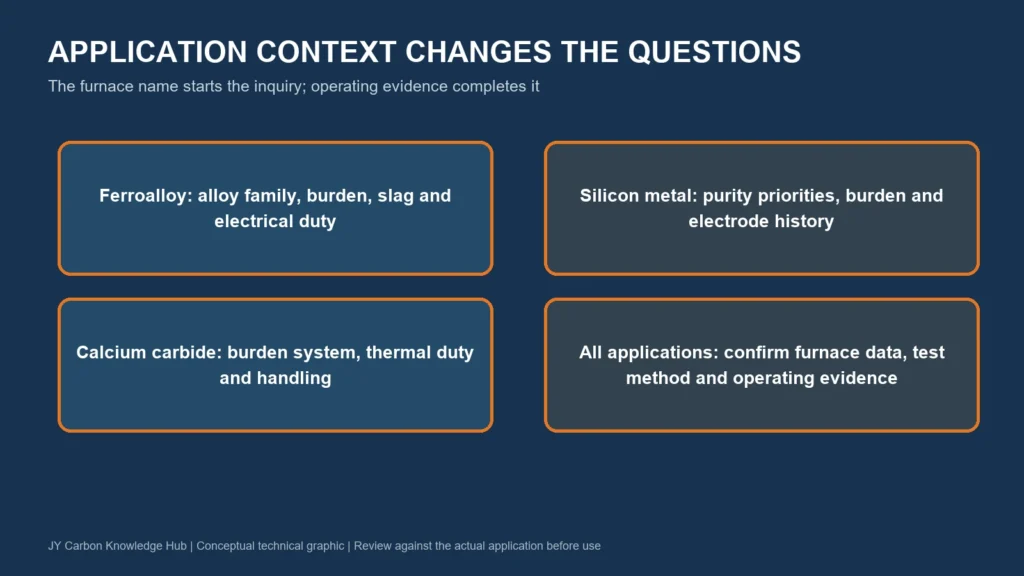
Application comparison framework. It does not assign a paste grade or operating value.
What Changes by Application
Ferroalloy is a broad family rather than one uniform duty. Alloy chemistry, burden composition, slag practice, furnace configuration and campaign strategy can vary. A paste that has been used in one ferroalloy operation should not automatically be treated as approved for every other alloy or furnace.
Silicon metal production places its own emphasis on furnace stability, material purity and the behavior of the carbon system within the process. Calcium carbide production has a different burden and product objective. These differences can change the customer’s acceptance priorities, but a public article should not convert them into universal property rankings without site-specific evidence.
| Application context | Questions that can change | Evidence needed before selection |
| Ferroalloy furnace | Alloy family, burden and slag practice, electrical duty and operating continuity | Furnace configuration, smelted alloy, operating history and agreed tests |
| Silicon metal furnace | Purity priorities, burden behavior, electrode-management history and product requirements | Customer chemistry targets, batch evidence and furnace observations |
| Calcium carbide furnace | Burden system, thermal duty, electrode consumption pattern and handling practice | Application record, paste form, inspection plan and storage/feeding context |
How Those Differences Affect the Inquiry
The first inquiry should state the smelted product precisely. “For SAF use” is not enough because it does not describe the process objective or the electrode’s recent operating behavior. The supplier should also know whether the request is for routine replenishment, a controlled trial, a response to a changed burden, or an investigation after an abnormal event.
Inspection targets should be handled in the same way. A target may come from a customer’s established specification, a validated trial or an applicable method. It should not be invented from a general application label. If two laboratories use different sample preparation or methods, apparently similar values may not be directly comparable.
A Comparison Framework
- Application: exact alloy, silicon or carbide product being produced.
- Furnace system: electrode configuration, casing arrangement and paste-handling route.
- Operating evidence: load pattern, continuity, recent changes and observed concern.
- Material evidence: current product designation, batch records and agreed test results.
- Commercial controls: packaging, storage, receiving inspection and trial acceptance process.
What to Send the Supplier
Send a concise application sheet rather than asking for a universal application grade. Include the smelted product, electrode-system description, paste form, current inspection requirements and the operating question that triggered the inquiry. The JY Carbon electrode paste page can be used as the product starting point, while the technical pillar guide provides the broader electrode-system context.
A responsible supplier response should identify what is known, what still needs confirmation and which conclusions depend on the customer’s furnace. That approach is more useful than presenting one formulation as suitable for every submerged arc furnace.
Sources
- Characterisation of a Real-World Søderberg Electrode. Metals, 2021. https://www.mdpi.com/2075-4701/11/1/5
- Impact of Electrode Paste on Soderberg Electrode Performance. INFACON IX. https://www.pyro.co.za/InfaconIX/510-Wilkinson.pdf
Written by Sterling Yang,Senior Vice President, Jincheng Jiyang Carbon Co.,Ltd.
Technically reviewed by Mr.Yang,Technical Director.


