Book Categories:

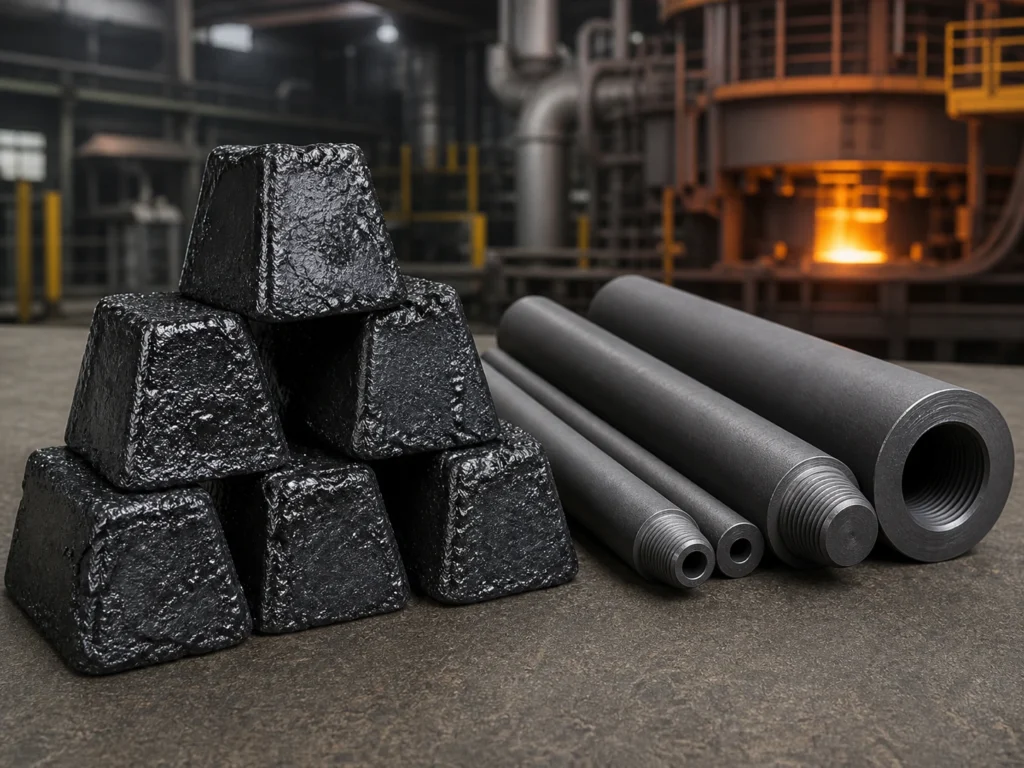
Electrode Paste and Graphite Electrodes: Applications, Production Logic, and Key Parameters
Introduction
Electrode paste and graphite electrodes are both industrial carbon products, but they are not selected in the same way. The correct choice depends on furnace type, current load, electrode working conditions, raw material requirements, and the quality parameters agreed between supplier and buyer.
For a buyer, the risk is not only whether the product can be supplied. The more important question is whether each batch is suitable for the furnace application and whether the supplier can explain how formulation, forming, inspection, and outsourced process supervision are controlled.
This article gives a practical introduction to electrode paste, graphite electrodes, their common applications, and the technical indicators that should be checked before placing an order. It is written for industrial buyers who need a clear starting point before discussing specifications, samples, or quotation.
1. What Are Electrode Paste and Graphite Electrodes?
Electrode paste, also called Soderberg electrode paste or carbon electrode paste, is used in self-baking electrode systems. During furnace operation, the paste is gradually baked by heat inside the electrode casing and becomes a conductive carbon electrode in service.
Graphite electrodes are pre-formed and machined carbon products used as conductive electrodes in electric furnace operations. They are normally selected by diameter, grade, nipple connection, current condition, furnace type, and required mechanical and electrical properties.
The basic difference is simple: electrode paste is baked during furnace operation, while graphite electrodes are supplied as finished or semi-finished conductive rods with defined dimensions and connection requirements.
| Item | Electrode Paste | Graphite Electrodes |
|---|---|---|
| Basic form | Paste or briquette-type carbon material | Pre-formed and machined electrode rod |
| Typical electrode system | Self-baking Soderberg electrode | Replaceable electrode column with nipple connection |
| Selection focus | Baking behavior, ash, volatile matter, resistivity, furnace stability | Diameter, grade, resistivity, density, strength, nipple fit, dimensional tolerance |
| Common application direction | Submerged arc furnace operations | EAF, LF, and selected small-to-medium furnace applications |
2. Common Industrial Applications
Electrode paste is mainly associated with submerged arc furnace applications where a self-baking electrode process is used. Typical application areas include ferroalloy production, calcium carbide production, silicon-related smelting, and other continuous high-temperature furnace operations.
Graphite electrodes are widely used in electric arc furnace and ladle furnace operations. For small and medium diameters, such as Φ50 mm to Φ200 mm, the application may include small-to-medium EAF lines, ladle refining, ferroalloy operations, and other furnace systems where diameter, connection fit, and stable electrical performance matter.
The same product name can mean different requirements in different plants. A calcium carbide furnace, a ferroalloy submerged arc furnace, and a small EAF line may all need carbon electrodes, but the target indicators and failure risks are not identical.
| Application | Product Usually Considered | Buyer Should Confirm |
|---|---|---|
| Ferroalloy submerged arc furnace | Electrode paste or selected carbon electrode products | Furnace type, current load, paste form, ash target, resistivity target, consumption behavior |
| Calcium carbide furnace | Electrode paste | Baking stability, volatile matter, ash control, fixed carbon, furnace operation conditions |
| Silicon-related smelting | Electrode paste or carbon electrode products | Furnace load, impurity sensitivity, paste behavior, required inspection items |
| Small-to-medium EAF or LF | Graphite electrodes | Diameter, grade, nipple type, resistivity, bulk density, strength, dimensional tolerance |
3. Why Product Selection Should Start From Furnace Conditions
A carbon product cannot be evaluated by product name alone. Furnace size, current intensity, feeding pattern, electrode consumption, raw material sensitivity, and operating discipline all affect what specification is suitable.
For electrode paste, buyers should describe the furnace application before asking for price. The supplier needs to know whether the paste is used for ferroalloy, calcium carbide, silicon manganese, silicon metal, or another application, because the control focus may change.
For graphite electrodes, buyers should confirm diameter, length, nipple type, thread requirement, furnace type, grade target, and any existing consumption or breakage problem. Without this information, a quotation may look fast but remain technically incomplete.
4. Production Logic Behind Stable Carbon Products
Stable carbon products start with raw material selection and ratio control. Different carbon raw materials, binders, particle sizes, and formulation choices influence forming behavior, baking behavior, electrical performance, ash level, and mechanical strength.
Kneading is one of the key process steps because it determines whether raw materials and binder are mixed evenly enough for consistent forming and batch behavior. Poor kneading stability may lead to uneven structure, unstable use behavior, or inconsistent test results.
Forming controls product shape, density distribution, dimensional stability, and handling performance. For electrode paste, forming can affect packaging form and furnace feeding behavior. For graphite electrodes, forming and later machining are connected with size control and connection fit.
For JY Carbon, the in-house control focus should be communicated clearly: raw material selection, ratio control, kneading, forming, inspection, and batch accountability. Calcination, baking, and graphitization should be described as outsourced or partner-managed processes when relevant, with quality supervision rather than full-chain ownership claims.
| Process Area | Why It Matters | JY Carbon-Safe Communication |
|---|---|---|
| Raw material selection | Affects ash, fixed carbon, impurity level, and consistency | Selected according to product application and agreed specification |
| Ratio control | Affects electrical and mechanical balance | Managed through formulation experience and batch records |
| Kneading | Affects material uniformity and forming stability | Controlled as an in-house process focus |
| Forming | Affects shape, density distribution, and handling | Controlled in-house with inspection before shipment |
| Outsourced thermal processes | May affect final structure and performance when applicable | Managed through qualified partners, process records, and final inspection |
| Final inspection | Confirms shipment batch against agreed requirements | Checked before shipment with reportable parameters |
5. Key Technical Parameters Buyers Should Understand
Electrical resistivity is one of the most important indicators for conductive carbon products. It helps buyers understand whether the product is suitable for the intended electrical load, but it should always be reviewed together with application conditions and other parameters.
Ash content reflects the inorganic residue in the carbon product. In applications sensitive to impurity input, ash control may become a major discussion point between buyer and supplier.
Fixed carbon and volatile matter are especially relevant for electrode paste because they are connected with carbon content, baking behavior, and furnace operation stability. The acceptable target should be confirmed according to customer application and lab test method.
Bulk density helps evaluate the compactness of a carbon product. For graphite electrodes, density is often reviewed together with resistivity, strength, and porosity-related indicators.
Flexural strength and compressive strength are mechanical indicators. They do not replace furnace trial results, but they help buyers assess whether the product has the required strength for handling, installation, and service conditions.
The coefficient of thermal expansion is relevant when a product must remain dimensionally stable under temperature change. For graphite electrodes, it is commonly reviewed with electrical and mechanical properties before final grade selection.
Particle size distribution is important for electrode paste formulation and forming behavior. It can influence packing structure, binder demand, baking behavior, and final electrode stability.
| Parameter | Why Buyers Check It | Product Relevance |
|---|---|---|
| Electrical resistivity | Conductive performance and load suitability | Electrode paste and graphite electrodes |
| Ash content | Impurity control | Especially important for paste and impurity-sensitive applications |
| Fixed carbon | Carbon content and use value | Electrode paste and other carbon products |
| Volatile matter | Baking behavior and operation stability | Electrode paste |
| Sulfur content | Impurity and process sensitivity | Application-dependent |
| Bulk density | Compactness and consistency | Graphite electrodes and formed carbon products |
| Flexural strength | Mechanical resistance under bending stress | Graphite electrodes |
| Compressive strength | Mechanical resistance under compression | Carbon products where handling or load matters |
| Thermal expansion coefficient | Dimensional stability under temperature change | Graphite electrodes |
| Particle size distribution | Formulation and forming behavior | Electrode paste |
| Apparent porosity | Structure and performance consistency | Graphite electrodes and baked carbon products |
6. How Inspection Supports Batch Consistency
Inspection is not only a final paperwork step. For industrial buyers, inspection provides a way to connect a shipment batch with agreed parameters, production records, and practical application requirements.
A practical inspection system should include raw material checks, process records, sampling, lab testing, and final inspection before shipment. When third-party inspection is required, it should be agreed before production or before shipment arrangement.
For outsourced processes such as calcination, baking, or graphitization, the communication should focus on supplier qualification, process documentation, batch tracking, and final inspection. This is more credible than hiding the outsourced nature of the process or overstating ownership.
7. What Information Buyers Should Provide Before Quotation
A useful inquiry should include more than a product name. The more clearly the buyer describes application, size, target parameters, and annual or monthly demand, the faster the supplier can judge technical fit and prepare a realistic quotation.
For electrode paste, the buyer should provide furnace type, application, paste form requirement, target indicators, packaging requirement, and historical consumption issues if available.
For graphite electrodes, the buyer should provide diameter, length, grade target, nipple and thread requirement, furnace type, monthly demand, destination port, and any inspection requirement.
| Product | Minimum Inquiry Information |
|---|---|
| Electrode paste | Application, furnace type, paste form, target ash, target resistivity, fixed carbon or volatile matter requirement if available, quantity, packaging, destination |
| Graphite electrodes | Diameter, length, grade target, nipple/thread details, furnace type, target resistivity or density if available, quantity, destination, inspection requirement |
8. How JY Carbon Approaches Product Fit
JY Carbon’s strength should be understood through process control rather than broad marketing claims. The company focuses on raw material selection, ratio management, kneading stability, forming consistency, inspection, and batch accountability.
With around 40 years of technical accumulation in carbon product processing, JY Carbon can support buyers by discussing furnace application, product form, key indicators, and inspection requirements before quotation.
For graphite electrodes, JY Carbon is especially relevant to buyers looking for small and medium diameters from Φ50 mm to Φ200 mm. For electrode paste, the discussion should start from the furnace application and agreed inspection parameters.
9. Practical Selection Checklist
Before comparing suppliers, buyers should first define the operating context. A low price is not useful if the product does not match furnace conditions, connection requirements, or inspection expectations.
The checklist below can be used before sending an inquiry or evaluating a supplier’s reply.
| Checkpoint | Why It Matters |
|---|---|
| Furnace type and application | Determines whether paste or graphite electrode is suitable |
| Product size or form | Affects feeding, installation, and connection |
| Electrical requirement | Helps review resistivity and load suitability |
| Impurity sensitivity | Helps confirm ash, sulfur, and related indicators |
| Mechanical requirement | Helps review strength and handling risk |
| Inspection requirement | Defines what must be tested before shipment |
| Quantity and delivery plan | Affects production planning, packaging, and logistics |
| Destination port | Supports realistic freight and lead-time discussion |
FAQ
What is the main difference between electrode paste and graphite electrodes?
Electrode paste is used in self-baking electrode systems and forms the working electrode during furnace operation. Graphite electrodes are pre-formed conductive rods, usually machined to defined dimensions and connection requirements before shipment.
Can one carbon product be used for all furnace types?
No. Furnace type, current load, product form, impurity sensitivity, and inspection requirements vary by application. A product suitable for one furnace may not be suitable for another without specification adjustment.
Which parameters should be checked for electrode paste?
Common discussion points include electrical resistivity, ash content, fixed carbon, volatile matter, sulfur content, and particle size distribution. Exact target values should be confirmed by application, customer requirement, and lab test method.
Which parameters should be checked for graphite electrodes?
Buyers often review diameter, length, grade, electrical resistivity, bulk density, flexural strength, compressive strength, thermal expansion coefficient, apparent porosity, nipple fit, and dimensional tolerance.
Why should outsourced processes be discussed openly?
Open communication is more credible for industrial buyers. If calcination, baking, or graphitization is handled by qualified partners, the supplier should explain supplier selection, process records, batch tracking, and final inspection.
What should I send before asking for a quotation?
Send the product type, furnace application, size or paste form, target parameters, monthly or annual demand, destination port, packaging requirement, and inspection requirement. This allows the supplier to prepare a more technically useful quotation.
If you are selecting electrode paste or graphite electrodes for a furnace application, send your furnace type, product size or paste requirement, target indicators, demand volume, and destination port. JY Carbon can review the application and provide a specification-based technical quotation.