
A component-level explanation of the equipment that contains, energizes and advances a self-baking electrode.
Direct Answer
A Soderberg electrode system combines a steel casing, internal fins or ribs, contact shoes, a paste column, suspension and slipping equipment, and the furnace working end. Each part has a different job: contain and stabilize the column, transfer current, support progressive baking, or advance the electrode as it is consumed. Safe performance depends on their interaction, not on one component alone.
Key Takeaways
- The casing acts as a mould and part of the current-transfer path during electrode formation.
- Internal fins support geometry and connect the casing to the developing carbon body.
- Contact shoes press against the casing and introduce current into the electrode assembly.
- Slipping advances the column; it does not replace the thermal conditions needed for baking.
- Component observations must be interpreted with furnace load, paste level and operating history.
Table of Contents
- Casing and internal fins
- Contact shoes and current transfer
- Paste column and functional zones
- Suspension and slipping equipment
- What evidence to collect
Casing and Internal Fins
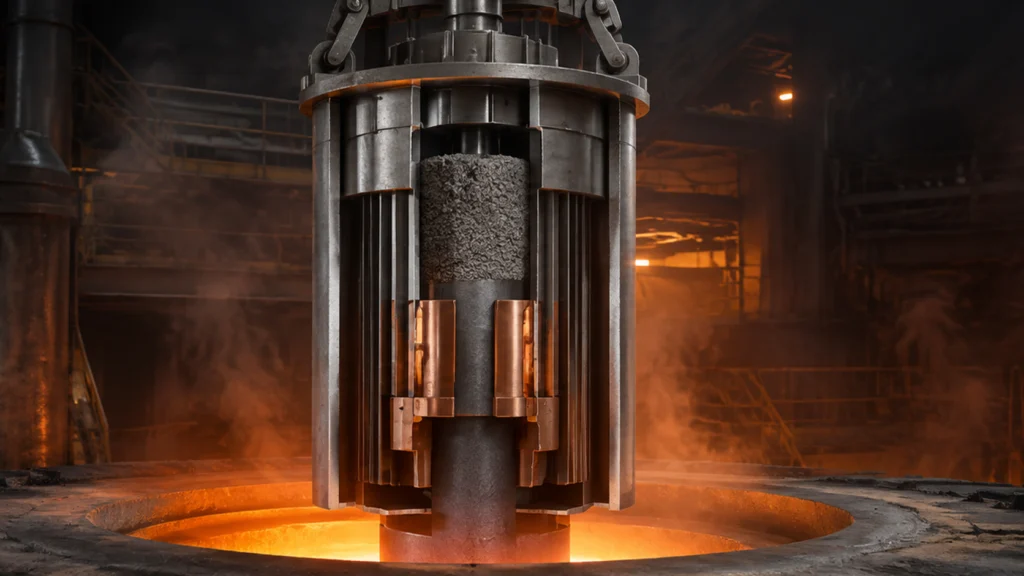
The steel casing contains the unbaked material and provides the shape in which the electrode develops. Published characterisation work describes longitudinal fins inside the casing that add dimensional stability to the casing and unbaked electrode (real-world Soderberg electrode). The casing should therefore be understood as a functional part of the electrode system, not merely as packaging around the paste.
Casing geometry, weld condition, fin arrangement and continuity belong to equipment and site engineering. A general article cannot approve a casing design or repair method. It can, however, show why observations such as deformation, damaged fins or abnormal contact marks deserve to be recorded before a material conclusion is made.
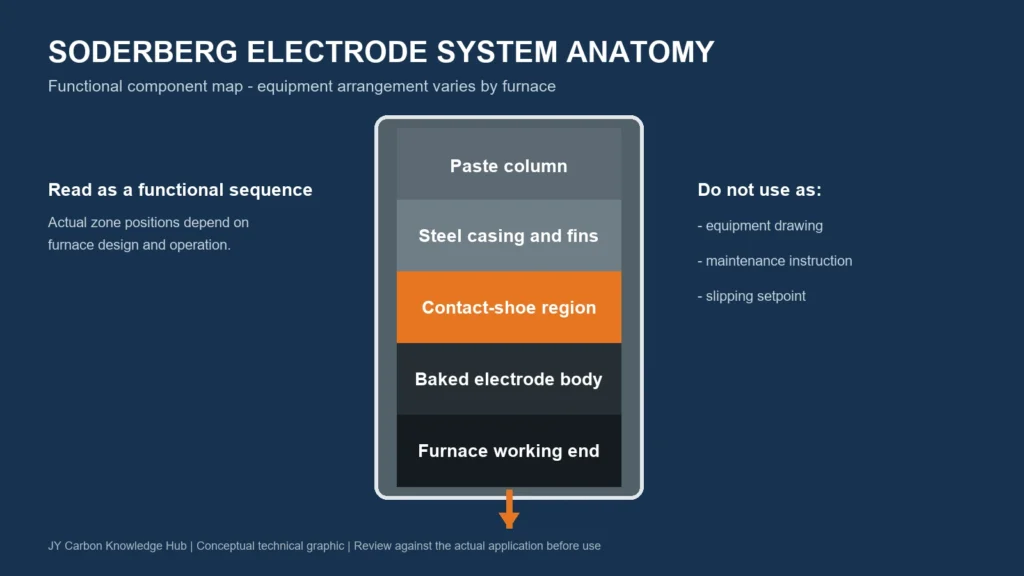
Component map only. Actual casing, contact and suspension details must be confirmed from site engineering documents.
Contact Shoes and Current Transfer
Contact shoes are conductive components pressed against the casing around the lower electrode assembly. Their role is to introduce electrical current into the electrode. The contact region is also important because the paste should have developed sufficiently before it reaches a location where current transfer and mechanical demands become critical (component description and field characterisation).
Irregular marks, uneven contact, local heating or mechanical movement around this area can have several possible causes. Equipment alignment, contact pressure, casing condition, electrode development and furnace operation may all be relevant. These symptoms require site procedures and qualified personnel; they are not suitable for remote adjustment instructions.
Paste Column and Functional Zones
The paste column is not uniform from top to bottom. Fresh material, softened paste, material undergoing carbonization and the baked working body occupy different functional regions. Their positions are outcomes of the thermal and operating environment rather than fixed dimensions that can be copied from another furnace.
Research into green and baked Soderberg materials shows that thermal properties change during heating and carbonization (thermal-property study). For operations, the practical implication is that paste addition, current, furnace heat and residence in the column must be reviewed together. A single laboratory value cannot locate the actual transition zone.
| Component | Primary function | Evidence worth recording |
| Steel casing | Contains and shapes the developing electrode | Geometry, weld condition, deformation and surface marks |
| Internal fins | Support casing and unbaked-electrode stability | Visible damage, discontinuity or abnormal movement |
| Contact shoes | Transfer current through the casing into the electrode | Contact pattern, alignment, local heating and equipment condition |
| Paste column | Provides material that progressively transforms | Addition record, observed levels, material form and batch identity |
| Slipping equipment | Advances the column as the working end is consumed | Movement history, alarms and approved operating records |
Suspension and Slipping Equipment
The suspension system carries the electrode assembly. The slipping system permits controlled downward movement relative to the holding arrangement. Slipping responds to electrode consumption and the site’s operating plan; it is not the mechanism that bakes the paste. If movement advances material before it has developed sufficiently, the resulting condition can become a serious operational risk.
For that reason, a technical supplier discussion should focus on records and observations rather than prescribing movement. The operating team remains responsible for the approved sequence, equipment interlocks, safety procedures and furnace-specific limits.
What Evidence to Collect
- A labelled sketch or approved photograph of the casing and contact region.
- Paste batch, supplied form, storage history and addition record.
- Relevant slipping and furnace-load history from the site system.
- The location, timing and repeatability of any abnormal mark, heat pattern or movement.
- Applicable maintenance findings and inspection results.
Use the JY Carbon electrode paste page when the question concerns supplied paste, and consult the Soderberg electrode terminology guide when the question concerns the relationship between paste and the self-baking electrode system.
Sources
- Characterisation of a Real-World Søderberg Electrode. Metals, 2021. https://www.mdpi.com/2075-4701/11/1/5
- Thermal Properties of Söderberg Electrode Materials. Metallurgical and Materials Transactions B, 2020. https://link.springer.com/article/10.1007/s11663-020-01890-0
Written by Sterling Yang,Senior Vice President, Jincheng Jiyang Carbon Co.,Ltd.
Technically reviewed by Mr.Yang,Technical Director.


