
A safety-first evidence guide for abnormal heating, marking or electrical behavior near the contact-shoe region of a self-baking electrode.
Direct Answer
Irregular current transfer near Soderberg contact shoes can involve contact condition, alignment, casing or fin integrity, electrode development, cooling or surrounding equipment, electrical loading and furnace operation. Treat local heating, arcing, unusual marks or movement as safety-relevant symptoms. Follow site isolation and escalation procedures, preserve evidence, and avoid adjusting equipment from a general article.
Key Takeaways
- The contact shoes introduce current through the casing into the electrode system.
- An abnormal contact-region symptom may have electrical, mechanical, thermal or electrode-development causes.
- Safe isolation and site engineering review come before close inspection or adjustment.
- Photographs, marks, temperatures and electrical records are useful only when collected under approved procedures.
- Do not blame paste quality before checking equipment and furnace evidence.
Table of Contents
- Why the contact region matters
- Classify the observed symptom
- Collect evidence by cause group
- Separate material and equipment questions
- Escalation package
Why the Contact Region Matters
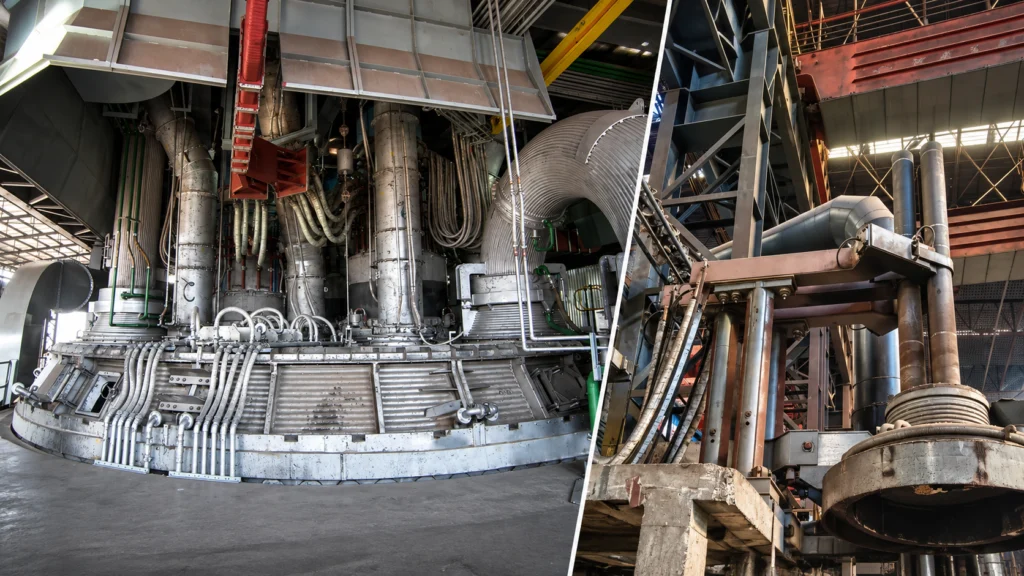
Contact shoes are conductive components pressed against the electrode casing to introduce current into the electrode. Published characterisation of an operating Soderberg electrode describes this arrangement and the importance of the paste becoming solid carbonaceous material before a critical lower contact region (real-world Soderberg electrode).
The contact region sits at the intersection of electrical transfer, mechanical contact, casing geometry, heat flow and electrode development. A symptom there is therefore not automatically a contact-shoe defect or a paste defect. The diagnostic process must consider the complete assembly.
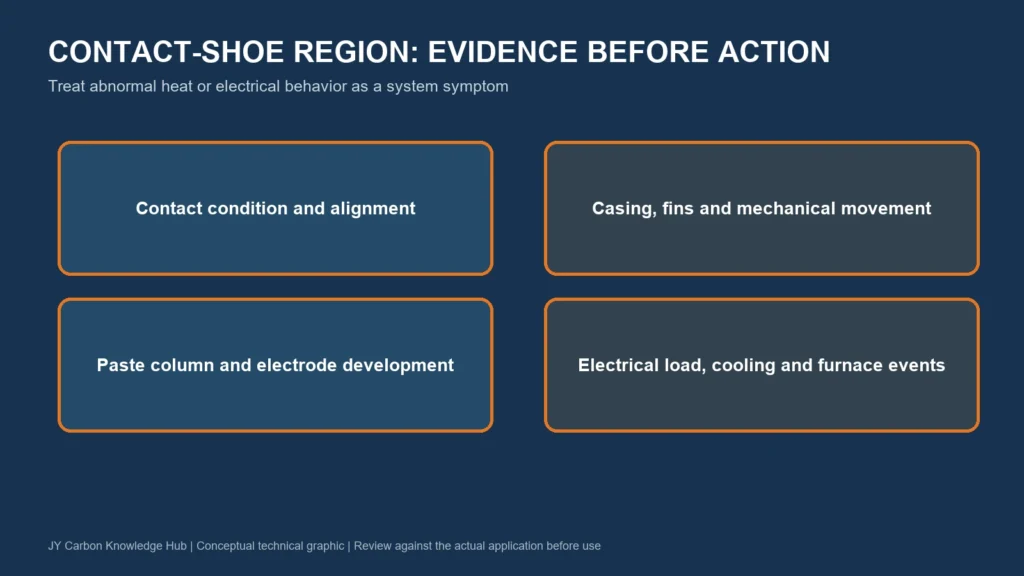
Safety-first diagnostic matrix. Inspection and corrective work must follow site isolation and engineering procedures.
Classify the Observed Symptom
Record what was observed without embedding a cause in the description. Useful symptom categories include localized heating identified by approved monitoring, unusual electrical noise or arcing, uneven contact marks, casing deformation, movement, cooling or equipment alarm, and a change in electrode behavior after a known event.
State the location, time, operating phase and whether the symptom is continuous or intermittent. Record what changed immediately before the event. Avoid close photography, touching, measuring or opening equipment unless the site procedure and responsible personnel permit it.
| Cause group | Evidence collected under site procedure | Do not conclude from one sign |
| Contact condition | Alignment, pressure or equipment record, contact pattern and maintenance history | A hot mark does not prove the material cause |
| Casing and fins | Geometry, weld or fin condition and movement history | Visible deformation does not identify the initiating event |
| Electrode development | Paste batch, additions, column observations and relevant movement record | A paste change does not prove inadequate baking |
| Electrical and thermal | Load history, alarm, approved temperature record and cooling condition | One peak does not explain the full timeline |
| Furnace operation | Shutdown, restart, burden, instability or electrode incident history | Coincidence does not establish responsibility |
Collect Evidence by Cause Group
Equipment evidence should come from qualified maintenance and electrical inspection. Electrode evidence should link paste batch, form, storage, additions and the relevant column-management record. Furnace evidence should identify load and process events that changed the thermal or mechanical environment.
Thermal-property research confirms that green and baked electrode materials behave differently as the column develops (Soderberg thermal-property study). That supports checking electrode development, but it does not permit a supplier to infer the actual baking position from a remote photograph or one temperature.
Separate Material and Equipment Questions
- Did the symptom begin with a paste batch or addition change?
- Did the symptom follow contact maintenance, alignment or equipment work?
- Was casing deformation or movement observed before the electrical symptom?
- Did furnace loading, shutdown, restart or instability change at the same time?
- Which evidence contradicts each proposed cause?
A material nonconformance can be investigated through retained samples and batch records. An equipment problem requires site inspection. A furnace-operation issue requires operating data. The most credible review assigns each question to the evidence source capable of answering it.
Escalation Package
Prepare a timestamped symptom description, safe photographs where authorized, equipment and alarm records, paste batch and addition history, recent maintenance, relevant electrical or furnace data, and actions already taken under site procedure. Use the JY Carbon electrode paste page when material conformity is one of the questions.
This article is an evidence guide, not an operating procedure. Isolation, access, measurement and corrective action must follow the furnace site’s approved safety and engineering controls.
Sources
- Characterisation of a Real-World Søderberg Electrode. Metals, 2021. https://www.mdpi.com/2075-4701/11/1/5
- Thermal Properties of Söderberg Electrode Materials. Metallurgical and Materials Transactions B, 2020. https://link.springer.com/article/10.1007/s11663-020-01890-0
Written by Sterling Yang,Senior Vice President, Jincheng Jiyang Carbon Co.,Ltd.
Technically reviewed by Mr.Yang,Technical Director.


