
A laboratory and procurement guide to making electrode paste test results representative, comparable and traceable to a batch.
Direct Answer
Electrode paste test results depend on more than the instrument. The sample must represent the defined batch, remain identifiable through handling, and be prepared according to the agreed method. Changes in sampling location, particle segregation, contamination, conditioning or specimen preparation can change the result. A certificate is meaningful only when its sample and method are traceable.
Key Takeaways
- A laboratory result describes the submitted specimen, not automatically the entire shipment.
- Sampling should define the lot, locations, increments, composite method and retained sample.
- Sample conditioning and specimen preparation must follow the same method when results are compared.
- Chain-of-custody and batch identity help separate material variation from handling or laboratory variation.
- Disputed results should trigger a method review before a technical conclusion.
Table of Contents
- Start with the decision
- Build a representative sample
- Control preparation and conditioning
- Compare results correctly
- Handle a disputed result
Start With the Decision
The sampling plan should begin with the question the result must answer. Incoming inspection, production control, pre-shipment release and a customer complaint do not necessarily use the same sampling point or responsibility. Define the lot and decision before collecting material; otherwise the laboratory may produce a precise result for an undefined population.
The agreed specification should name the test item and method. It should also state whether the sample represents raw paste, a prepared specimen or material transformed under a defined laboratory procedure. This distinction is especially important for carbon paste because its structure and binder condition change during heating and preparation.
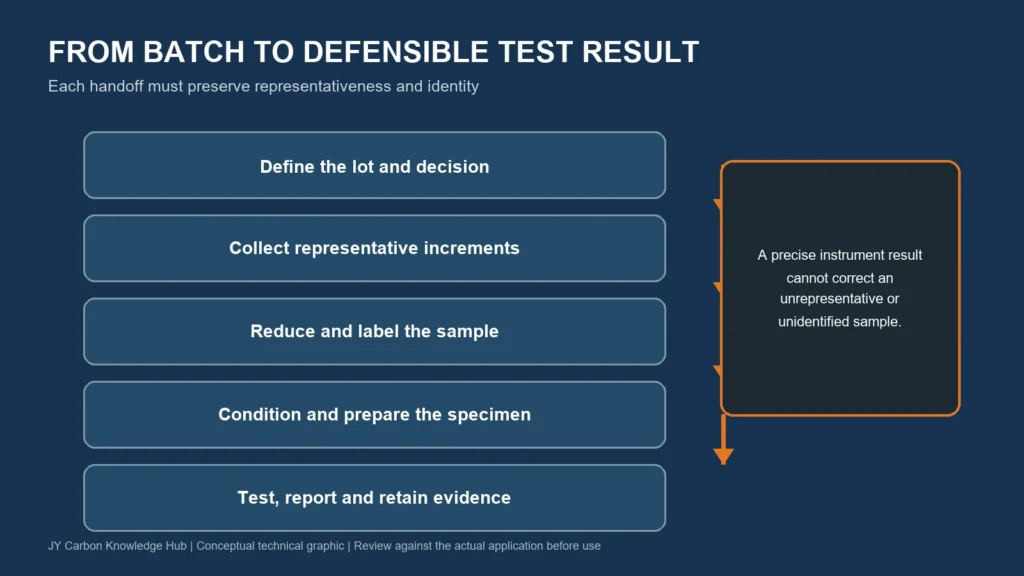
Sampling and preparation workflow. The exact procedure must follow the agreed test method and batch scope.
Build a Representative Sample
A shipment or production batch can contain many individual pieces or packages. One convenient piece may not represent the defined lot. A sampling plan should identify where increments are taken, how they are combined, what contamination controls apply and which sample is retained for possible verification.
Segregation risk should be considered whenever particle size or material form can vary within the handling route. Tools and containers should be clean and appropriate for the analysis. Labels should preserve product, batch, sampling point, date and responsible person without relying on memory or an informal message.
| Stage | Control question | Record to retain |
| Define the lot | Which production or shipment quantity does the decision cover? | Product designation, batch and package references |
| Collect increments | Do the locations represent the agreed lot and handling condition? | Sampling map and collection record |
| Combine or divide | Was the sample reduced without selective loss or contamination? | Composite and sample-reduction method |
| Condition and prepare | Was the agreed preparation sequence followed? | Method, equipment and specimen identity |
| Test and retain | Can the result be linked back and checked if disputed? | Report, raw result and retained-sample record |
Control Preparation and Conditioning
Research using thermomechanical analysis demonstrates that electrode-paste raw materials are prepared and tested under defined laboratory conditions (thermomechanical characterisation method). Its published conditions are not a universal commercial test procedure. They illustrate why specimen geometry, conditioning, heating history and method must accompany any interpretation.
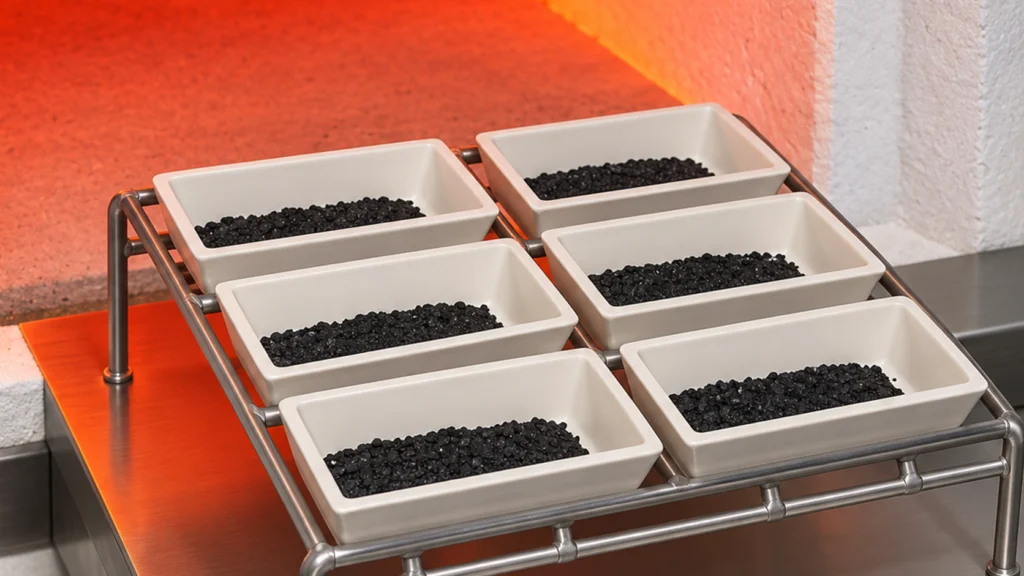
Grinding, cutting, heating, cooling, compaction or baking can change the specimen presented to the instrument. If a buyer and supplier use different preparation routes, the results may answer different questions even when the parameter name is identical. The method comparison must come before a pass/fail argument.
Compare Results Correctly
- Confirm the same product state and batch scope.
- Confirm the same named test method and revision where applicable.
- Compare conditioning, specimen preparation and calculation basis.
- Review instrument calibration and quality-control checks.
- Check whether the reported value is an individual result, average or another defined statistic.
Do not average incompatible results to make a disagreement disappear. If the methods or specimens differ, record the difference and agree on a verification route. A third-party laboratory can be useful only after the parties agree what it should sample and which method it should apply.
Handle a Disputed Result
Freeze the relevant batch identity and preserve available samples and records. Review the original sampling plan, packaging condition, transport history, preparation method, raw laboratory data and retained sample. Decide whether retesting, resampling or method alignment addresses the actual uncertainty.
For a supplier discussion, request the applicable inspection method and batch certificate through the JY Carbon electrode paste page. A useful report should allow the reader to connect the value to a defined product, batch, sample and method.
Sources
- The Use of Thermomechanical Analysis to Characterise Söderberg Electrode Paste Raw Materials. Minerals Engineering, 2013. https://www.sciencedirect.com/science/article/pii/S0892687513001210
- ASTM E105-21 — Standard Guide for Probability Sampling of Materials. https://store.astm.org/e0105-21.html
Written by Sterling Yang,Senior Vice President, Jincheng Jiyang Carbon Co.,Ltd.
Technically reviewed by Mr.Yang,Technical Director.


